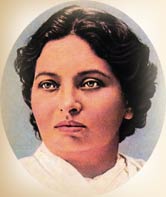
Born In: Gangamul, Karnataka
Died On: April 5, 1922
Career: Poet, Scholar & Social Reformer
Nationality: Indian
Pandita Ramabai was born during those times when the women folks of India
were considered a little more than slaves, to serve their husband and bear
children. They were not allowed to study, or go out on their own and a
majority of Hindu women were married off when they were children to men
who were decades older. Naturally there were large number of child widows
who were made to live the most punishing lives. Pandita Ramabai was
fortunate in many ways. Though she was born in a Brahmin family her father
was a liberal. Her father had married his wife when she was nine years old
and he was forty. But defying social pressures he educated both his wife
and children. Her father even refused to get Ramabai married until she
becomes an adult. It was from him that she was inspired towards social
reform. During her travels first with her father and then with her
brother, she saw how cruelly women were treated. Disgusted she decided to
do something about it. She also lost her faith in Hinduism which she
though supported the degradation of women by men. She converted to
Christianity and spent her life rescuing women and widows from poverty,
ostracization and death and giving them a new life through education.
Childhood
In the year 1858, in a village nestled amidst the thick forests of
Gangamul was born a girl who would become one of the earliest and foremost
champions of woman rights. The girl was christened Ramabai by her father,
Anant Shastri Dongre who was a wealthy and orthodox Brahmin scholar.
Unlike other Brahmins of his village Anant Shastri Dongre was quite a
liberal, who considered that every woman has the right to education. So,
he took it upon himself to educate first his wife after marriage and then
his daughter, Ramabai. But such liberal views were anathema to the high
caste villagers. As such, when he took to teaching his wife, they
ostracized him, forcing him to move outside the village and live in a hut
in the forest. Later, he traveled widely with his family from village to
village reading the Puranas at temples, fairs and holy places. By the age
of twelve Ramabai had memorized eighteen thousand verses from the Puranas
becoming proficient in Sanskrit.
Early Life
When Ramabai was sixteen years old, her parents died due to an outbreak of
famine. Being all alone she decided to travel throughout India with her
older brother, giving discourses from the Holy Scriptures and preaching
social reform. The brother and sister first went to Calcutta where Ramabai
impressed the high caste Brahmins with her knowledge of the Puranas. So
astonished were they with her wisdom, particularly as very few women could
read at that time that they bestowed the title Pandita (scholar) and
invited her to give lectures and visit places of learning. It was during
these travels that she saw the plight of women particularly child-widows.
It was then that she resolved to devote her life to work towards the
upliftment of women. Soon her brother too passed away and she married his
friend, in 1880, Bipen Behan Das Medhavi, who, though of a lower caste,
sympathized with her selfless resolve. Soon after, they had a child whom
they named Monorama. Along with her husband, Pandita Ramabai decided to
set a school for widows but even before the plan could materialize, her
husband passed away due to cholera, just eighteen months after marriage.
According to the custom prevalent at that time, a Hindu widow could not
stay at her husband's house, so, Padita Ramabai left Calcutta and went to
Pune. Here she established the Arya Mahila Samaj to promote female
education and also work towards eradicating child marriage. She also
started learning English and wrote a book called Stree Dharma Niti (Morals
for Women). While setting up the Samaj, Ramabai realized that she required
more training in order to successfully pursue her work and decided to go
to England.
Travels Abroad
In 1883, Pandita Ramabai went to England along with her friend the English
missionary Miss Hurford, and was made a professor of Sanskrit at
Cheltenham Female College. There she also learned English and studied
higher education as well as English Literature. In England, already
distraught with the rot in Hinduism that she saw in India, Padita Ramabai
converted to Christianity. In 1886, she received an invitation to attend
the graduation ceremony of her cousin, Dr. Anandibai Josh. There she
befriended Dean Bodley of the Women's Medical College who encouraged her
to work in America. Pandita Ramabai got the opportunity to study the
American public school system and also received industrial training.
Pandita Ramabai also spent her time in America giving lectures. During
this time she wrote the book "High Caste Hindu Woman". She started
networking with influential people and lobbying for aid to start a secular
school for child widows in India. Because of her repeated appeals a public
meeting was held in 1887 in the Channing Hall of the American Unitarian
Association Building. With her keen wit and flair for speaking, Pandita
Ramabai was able to move the audience and Rev. Charles G. Ames appointed a
provincial committee of women to consider her plan and act on it. The
result was the formation of an association to act as the custodian of
funds that Ramabai could use for her work.
Return To India & Social Work
In 1889, Pandita Ramabai returned to India after a period of six years,
she continued her crusade for the betterment of the women. She wrote about
her American experience in a book titled 'United States Chi Lokasthiti Ani
Pravasvrutta' (Status of Society of United States and a travelogue).
Within six weeks of her return to the country, pandita Ramabai had
established a school called Sharada Sadan in Bombay. During this time she
also became more involved in Christianity famously noting that "One thing
I knew by this time," she wrote, "that I needed Christ and not merely His
religion... I was desperate... What was to be done? My thoughts could not
and did not help me. I had at last come to an end of myself, and
unconditionally surrendered myself to the Saviour; and asked Him to be
merciful to me, and to become my righteousness and redemption, and to take
away all my sin...." Pandita Ramabai faced considerable opposition from
many Indian reformers and the press for they perceived that she was
influencing her students to Christianity. In 1904 she started translating
the Bible in Marathi and by 1913 the New Testament was published and by
1924 the complete Bible was published. From 1896-97 and from 1900-01,
India was devastated by two famines in Madhya Pradesh and Gujarat
respectively. Ramabai rescued about 2000 women and girls from perishing
from hunger and housed them at a 100 acre farm at Kedgaon, which came to
be known as the Mukti Mission (The Home of Salvation).
Recognition
For her services to the community the British Raj in 1919 awarded her the
Kaiser-I-Hind medal. Ramabai is also honored with a feast day on the
liturgical calendar of the Episcopal Church (USA) on April 5. The
Government of India recognized her contributions for the upliftment of
women in India and issued a commemorative stamp on 26th October 1989.
Death
In July 1921 her daughter Manorama passed away and in April the next year
Ramabai too breathed her last at the age of sixty four. For almost twenty
years Pandita Ramabai had pursued her mission to uplift the women
particularly the child widows of India inspiring many and saving
countless.
Timeline
1858: Pandita Ramabai was born in Gangamul, Karnataka.
1880: Married Bipen Behan Das Medhavi, a friend of her
brother.
1883: Left for England and became a Professor of Sanskrit
at Cheltenham Female College.
1886: Moved to America.
1887: An association was formed to fund her works in
India.
1889: Returned to India to work towards the upliftment of
women.
1904: Started translating the Bible to Marathi.
1919: Conferred the Kaiser-I-Hind medal for her community
service.
1989: A commemorative stamp was launched in her honor by
the Government of India.
1922: Died at the age of sixty four.